Varietal
Tasting notes
Colour: A lovely deep garnet red with purple highlights.
Nose: A fruity bouquet of raspberry and Morello cherry, combined with spicy and vanilla notes.
Palate: Full and fleshy on the palate, with flavours of black fruit (blackcurrant) and gingerbread. The tannins are nicely textured and mature. Long, tasty notes on the finish.
Food and wine pairing
Enjoy with pâtés, terrines, cold meats, braised meats or meats in sauce (braised veal, stewed poultry, roast Bresse poularde), cheeses such as Reblochon.
Serving suggestions
Ideally served at around 15°C.(59°F.).
Ageing potential
Already pleasant in its youth, this red Burgundy will easily age for 7 years in good cellaring conditions.
Origins
A Côte Chalonnaise appellation. This Côte Chalonnaise cru was the favourite wine of the French King Henri IV (1553-1610).
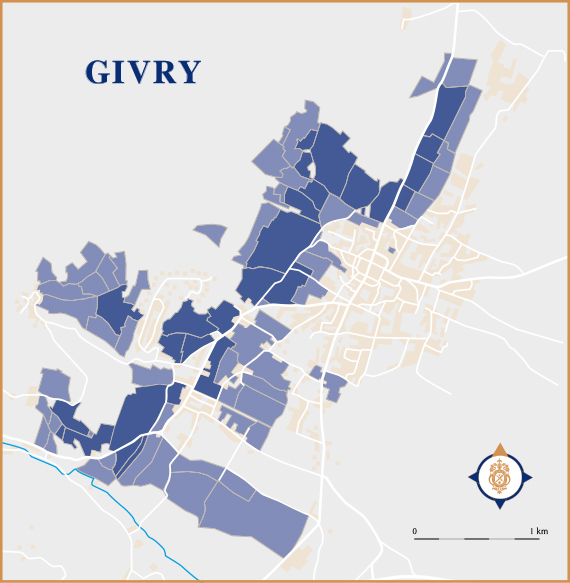
It is produced in the communes of Givry (with its hamlets Poncey, Cortiambles and Russilly), Dracy-le-Fort, and Jambles – a corner of Paradise for wine-growing, surrounding what has been a fortified location since the Middle Ages. Its AOC dates from 1946.
The vineyard under this appellation extends over
237 hectares producing red Burgundies from Pinot Noir and 45 hectares of white (Chardonnay). 41.5% of the vineyard is classified as Premier Cru. Givry is mainly producing red wines (85%).Vinification and maturing
Harvested by hand. 100% sorting and destemming. Alcoholic fermentation and maceration take place at controlled temperature in open vats for 18 days. We punch down the cap regularly during alcoholic fermentation. The wine is aged in barrels for 9 months.
 Vintage : 2025
The 2025 growing season in Burgundy was marked by a rainfall deficit of around 30% compared with 2024, combined with an early harvest. The first cuts of the secateurs took place on August 25 in the Beaune Premier Cru vineyards, notably in Savigny-lès-Beaune (Clos du Roi and Marconnets).
Across the entire vineyard, harvesting began up to two weeks earlier than in 2024 and extended over a longer-than-usual period to adapt to weather conditions, which turned rainy at the outset of the harvest. All grapes were brought in on time: sanitary conditions were very good, and the fruit shows an aromatic concentration that suggests elegant, refined wines. While volumes appear stable compared to 2024, they nevertheless remain below the five-year average.
At the time of the first run-offs in mid-September, red wines were showing gentle extraction with fine colour. White wines, meanwhile, quickly revealed themselves to be rich, flavoursome and concentrated, while retaining fine freshness thanks to cool nights that preserved acidity.
In summary, 2025 is shaping up to be a vintage of character and quality, for both red and white Burgundy wines.